
eBooks
200 Books found- Featured

Über die Dichtkunst beim Aristoteles by Aristotle
Authors: Aristotle, 385 BCE-323 BCE
So, you know how we talk about movies being 'good' or 'bad'? Aristotle was doing that for plays over 2,300 years ago. In 'Über die Dichtkunst beim Aristoteles' (usually called 'Poetics'), he tries to crack the code of what makes a story work. It's not about flowery language; it's about why some tragedies make you feel real pity and fear, while others just leave you bored. The book is basically the original rulebook for storytelling, and it's wild to see how many of his ideas about plot and character still shape the books, shows, and movies we love today. Think of it as the ancient Greek guide to writing a blockbuster.
- Featured
Three men on the bummel by Jerome K. Jerome
Authors: Jerome, Jerome K. (Jerome Klapka), 1859-1927
Remember those three hilarious friends who got into such a mess on the river in 'Three Men in a Boat'? Well, they're back, and this time they've decided that a bicycle tour through the Black Forest in Germany is a splendid idea. What could possibly go wrong? Join George, Harris, and our narrator J. as they navigate foreign customs, unreliable maps, and their own spectacular talent for turning a simple vacation into a rolling comedy of errors. It's less about the destination and all about the wonderfully absurd journey.
- Featured

The Paradise Mystery by J. S. Fletcher
Authors: Fletcher, J. S. (Joseph Smith), 1863-1935
Okay, so picture this: a quiet cathedral town, a respected doctor found dead in the Dean's garden, and a will that disappears. That's the setup for 'The Paradise Mystery,' a classic whodunit that feels both cozy and genuinely puzzling. It's not just about finding the killer; it's about untangling a web of secrets that everyone in the town seems to be hiding. If you love mysteries where the setting is a character itself and every polite conversation might hold a clue, you'll get hooked fast. Think of it as a quieter, British cousin to some of the more dramatic thrillers—perfect for a rainy afternoon with a cup of tea.
- Featured
Poésies Complètes - Tome 2 by Théophile Gautier
Authors: Gautier, Théophile, 1811-1872
Hey, have you ever felt like you're just going through the motions of life? That's the haunting question at the heart of Théophile Gautier's second volume of complete poems. Forget the stiff, formal poetry you might remember from school. This collection is a vibrant, sometimes desperate, search for beauty and meaning in a world that can feel pretty ordinary. Gautier doesn't just describe a sunset; he wrestles with it, trying to squeeze every drop of color and emotion onto the page. It's less about a single story and more about the lifelong conflict between our daily routines and our deepest artistic dreams. If you've ever looked at a painting and felt a pang of longing, or wondered if there's more to life than what's in front of you, this book gets it. It's like having a conversation with a brilliant, slightly melancholic friend who reminds you to really see the world.
- Featured
Minor Dialogues, Together With the Dialogue on Clemency by Lucius Annaeus Seneca
Authors: Seneca, Lucius Annaeus, 5? BCE-65
Hey, have you ever felt like the world is just too much? Too much noise, too many opinions, too much pressure? That’s exactly where Seneca starts. 'Minor Dialogues' isn’t a single story; it’s a collection of ancient therapy sessions. Seneca tackles the big, messy feelings we all have—anger, grief, the shortness of life—and argues that the real conflict isn’t out there in the world. It’s inside us. The 'Dialogue on Clemency' adds a fascinating twist, where he tries to convince a young, powerful emperor that true strength looks like mercy, not cruelty. It’s a surprisingly direct chat about how to stay sane and decent when everything feels chaotic.
- Featured
Martine's Hand-book of Etiquette, and Guide to True Politeness by Arthur Martine
Authors: Martine, Arthur
Ever wondered how people in the 1800s navigated a dinner party without accidentally insulting the host? Or what the proper way to decline a dance invitation was? Arthur Martine's 1866 guide to etiquette is like a time capsule of social anxiety. It’s not just about which fork to use; it’s a fascinating window into the invisible rules that governed everyday life, from courtship to conversation. Reading it today is equal parts hilarious and humbling—you'll laugh at the overly formal advice, but then catch yourself wondering if we’ve lost something by throwing all the rules out. It’s a surprisingly fun peek into the past.
- Featured

Histoire parlementaire de France, Volume 2. by François Guizot
Authors: Guizot, François, 1787-1874
Hey, ever wonder how France actually built its modern government? Not the kings and queens part, but the messy, argumentative process of creating a parliament? That's what this book is about. Guizot, who was right in the middle of it all, takes you into the committee rooms and heated debates of the early 1800s. It's not a dry list of laws; it's the story of politicians trying to figure out how to share power after a revolution. Think of it as the 'behind-the-scenes' documentary of how French democracy learned to walk, complete with all the stumbling and fighting you'd expect.
- Featured

2 B R 0 2 B by Kurt Vonnegut
Authors: Vonnegut, Kurt, 1922-2007
Hey, if you're looking for a quick story that will make you think twice about all those 'perfect world' sci-fi fantasies, you have to check out Kurt Vonnegut's '2 B R 0 2 B'. It's a short story that packs a huge punch. Imagine a future where aging and disease are cured, and the population is perfectly controlled. Sounds great, right? The catch? To make room for a new baby, someone has to voluntarily die. The story follows a man in a maternity ward, faced with this impossible choice. It's a wild, dark, and weirdly funny setup that only Vonnegut could pull off. It'll stick with you long after you finish the last page.
- Featured
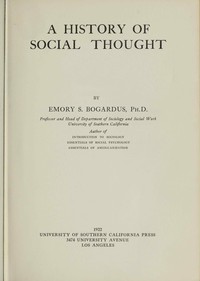
A history of social thought by Emory S. Bogardus
Authors: Bogardus, Emory S. (Emory Stephen), 1882-1973
Ever wonder where our ideas about society, community, and how we should live together actually come from? Emory Bogardus's classic book is like a guided tour through the minds of the thinkers who built the social world we live in. It's not about dry dates and events; it's about the arguments, the 'aha!' moments, and the sometimes-wild theories that shaped everything from our governments to our friendships. If you've ever questioned why society is set up the way it is, this book connects the dots from ancient philosophers to modern sociologists. It's a surprisingly readable map of the ideas that made us.