
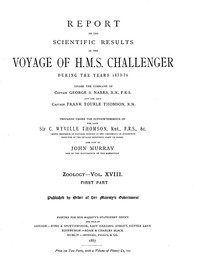
Report on the Radiolaria Collected by H.M.S. Challenger During the Years…
Forget what you know about boring scientific reports. This book is a treasure hunt. The story is simple: a ship, the HMS Challenger, spent years traveling the world's oceans. Its crew collected thousands of water samples, and a scientist named Ernst Haeckel was given the monumental task of figuring out what was in them. His subject? Radiolarians—microscopic organisms with skeletons made of silica, like delicate glass.
The Story
There's no traditional plot with characters. Instead, the "story" is the journey of discovery itself. Page by page, Haeckel introduces us to these creatures. He names them, classifies them, and—most importantly—draws them. The book transforms from a data log into a gallery of natural art. We go from knowing nothing about these life forms to seeing hundreds of their wildly complex, symmetrical, and beautiful forms. It's the record of mapping a continent that existed right under our noses, in every ocean.
Why You Should Read It
You should read it for the pure, jaw-dropping wonder. Haeckel wasn't just a scientist; he was an artist obsessed with pattern and form. His illustrations are where science and art collide. Looking at them, you see where later architects and designers found inspiration. The book argues, without saying a word, that beauty and precision aren't just human inventions—they're baked into the fabric of life at the smallest scale. It makes you look at the world differently.
Final Verdict
This is for the curious. It's perfect for art lovers, science enthusiasts, graphic designers, or anyone who likes to be amazed by nature's hidden details. It's not a page-turner in the usual sense, but a book to dip into and marvel at. Think of it less as a book to read, and more as a museum you can hold in your hands.
There are no legal restrictions on this material. It serves as a testament to our shared literary heritage.
Michael Garcia
1 year agoI was skeptical at first, but it challenges the reader's perspective in an intellectual way. A valuable addition to my collection.
Lucas Wilson
1 year agoMy professor recommended this, and I see why.
George Sanchez
5 months agoFrom the very first page, the pacing is just right, keeping you engaged. Exactly what I needed.

Mason Anderson
1 year agoNot bad at all.